

GST Filing for Contractors in Alberta: What You Need to Know
GST is something almost every growing contractor eventually has to deal with but filing a GST return is more than simply adding up the tax you’ve collected from customers.
You need to know what GST you collected, what GST you paid on eligible business expenses, which input tax credits (ITCs) you can claim, and how much you actually need to remit to the CRA.
For contractors, keeping the GST side of your bookkeeping organized throughout the year can make filing much easier and help prevent unpleasant surprises when a return is due.
Here’s what contractors in Alberta should know about GST filing.
Do contractors have to register for GST?
Not necessarily.
If your business is a “small supplier,” you generally don’t have to register for GST/HST. For most businesses, the small-supplier threshold is $30,000 of worldwide taxable supplies in either a single calendar quarter or over four consecutive calendar quarters. (Canada)
Once you exceed the applicable threshold, GST/HST registration can become mandatory.
You can also choose to register voluntarily before you’re required to.
If you’re unsure whether your business has reached the registration threshold, it’s worth reviewing your situation with a qualified tax professional or the CRA.
How much GST do Alberta contractors charge?
Alberta currently has a 5% GST rate and no provincial sales tax. (Canada)
However, contractors working across provincial borders need to be careful.
The GST/HST rate that applies to a taxable supply generally depends on the place-of-supply rules, so you shouldn’t automatically assume that every job performed for an out-of-province customer is subject to Alberta’s 5% rate. (Canada)
If you work in multiple provinces, make sure your bookkeeping system captures the information needed to determine the correct tax treatment.
What is a GST return?
A GST/HST return is how a registered business reports its GST/HST activity to the CRA for a particular reporting period.
In general, you report:
GST/HST you collected or were required to collect
Eligible input tax credits for GST/HST you paid or owe on business purchases and expenses
Other applicable adjustments, credits or amounts
The result is your net tax for the reporting period.
Depending on your situation, you may have an amount to remit to the CRA—or you may be entitled to a refund.
The CRA requires registered businesses to file a GST/HST return for each reporting period, even if there was no business activity or no net tax to report. (Canada)
GST collected isn’t the same as income
This is one of the most important concepts for contractors to understand.
If you invoice a customer $10,000 for a taxable service in Alberta, you would generally charge:
$10,000 service revenue
+$500 GST
=$10,500 invoice total
That $500 GST is not your revenue.
GST collected is an amount you collect on behalf of the government and generally need to account for when you file your GST return. The CRA specifically states that collected GST/HST is held in trust until it is remitted. (Canada)
That’s why spending the GST sitting in your bank account can create a cash-flow problem later.
A good bookkeeping habit:
Keep your GST payable balance visible throughout the year rather than waiting until filing time to find out what you owe.
What are input tax credits?
Input tax credits, commonly called ITCs, allow GST/HST registrants to recover GST/HST paid or payable on eligible purchases and expenses related to their commercial activities. (Canada)
For contractors, this can include GST paid on certain business expenses such as:
Materials and supplies
Equipment and equipment rentals
Fuel
Repairs and maintenance
Advertising
Accounting and professional services
Office expenses
Telephone and utilities
Commercial rent
Certain motor vehicle expenses
Whether an expense qualifies—and how much GST can be claimed—depends on the specific circumstances.
The CRA generally requires the purchase or expense to relate to your commercial activities, and you need sufficient documentation to support the claim. (Canada)
Not every expense gives you a full GST credit
This is where things can get more complicated.
If something is used partly for business and partly for personal purposes, you generally can’t simply claim 100% of the GST.
For example, if a vehicle is used for both business and personal driving, the GST/HST ITC generally needs to reflect the portion related to commercial activities. The CRA requires the method used to determine the business-use percentage to be fair and reasonable and applied consistently. (Canada)
Meals and entertainment also have special rules. For most businesses, only 50% of the GST/HST on eligible meals and entertainment expenses can generally be claimed as an ITC. (Canada)
This is one reason accurate bookkeeping matters.
You don’t want to simply claim every dollar of GST that appears on your credit card statement.
What records should contractors keep?
Your GST return is only as good as the records behind it.
The CRA says businesses need to keep records that support their GST/HST returns and ITC claims. This includes sales and purchase invoices and other records related to the business. (Canada)
For ITCs, your supporting invoices or receipts need to contain sufficient information to substantiate the claim. (Canada)
Generally, GST/HST records must be kept for six years from the end of the year to which they relate, although the CRA can require records to be kept longer in certain circumstances. (Canada)
For contractors, that means keeping organized records for things like:
Customer invoices
Supplier invoices
Material purchases
Equipment purchases
Fuel and vehicle expenses
Subcontractor invoices
Credit card purchases
Business receipts
GST/HST calculations
Filed GST returns
Don’t wait until the GST deadline to start looking for missing receipts.
Keeping your books current and properly categorized makes it much easier to identify eligible expenses and support your GST filing. It also helps prevent some of the common bookkeeping mistakes contractors make.
How often do contractors have to file GST?
Your GST reporting period determines how often you file.
Common reporting periods include:
Monthly
Quarterly
Annually
The CRA assigns reporting periods based on your circumstances, and eligible businesses may be able to elect a different reporting period. (Canada)
For monthly and quarterly filers, the return and payment are generally due one month after the end of the reporting period.
For most annual filers, the filing and final payment deadline is three months after the fiscal year-end.
There is an important exception for individuals with business income who file annually, have a December 31 fiscal year-end and meet the CRA’s conditions: the payment deadline is generally April 30, while the filing deadline is June 15. (Canada)
Your actual CRA account should always be checked for your specific reporting period and due dates.
What happens if you don’t owe anything?
You still need to file your GST return.
The CRA states that registered businesses must file a return for each reporting period even if they:
Had no business transactions or income
Have no net tax to remit
Are closing their GST/HST account and need to file a final return
A return with nothing to report is commonly referred to as a nil return. (Canada)
So don’t assume that having no GST owing means you can skip the filing.
What happens if you miss the GST deadline?
Late filing or late payment can result in penalties and interest.
The CRA can charge penalties and interest on returns or amounts that aren’t received by the applicable deadline. (Canada)
That’s why GST should be part of your regular bookkeeping process—not something you scramble to figure out four times a year.
A contractor’s GST checklist
Before filing your GST return, your bookkeeping should ideally include a review of:
Sales
☐ All customer invoices have been recorded
☐ GST charged has been recorded correctly
☐ Tax treatment has been reviewed for applicable sales
☐ Out-of-province transactions have been considered where relevant
Purchases and expenses
☐ Supplier invoices and receipts are recorded
☐ GST paid on eligible expenses has been captured
☐ Personal-use portions have been excluded where applicable
☐ Meals and entertainment have been reviewed for the applicable ITC limitation
☐ Large equipment and other significant purchases have been reviewed
Reconciliation
☐ Bank accounts are reconciled
☐ Credit cards are reconciled
☐ GST accounts are reconciled
☐ Missing documentation has been identified
☐ GST collected and ITCs claimed have been reviewed
Filing
☐ GST return is prepared
☐ Return is reviewed before submission
☐ Payment or refund amount is confirmed
☐ Filing and payment are completed by the applicable deadline
☐ Copy of the filed return and supporting records are retained
The biggest GST mistake contractors make
The biggest mistake isn’t necessarily filing late.
It’s waiting until filing time to understand what happened during the quarter.
If your bookkeeping isn’t current, you may not know:
How much GST you’ve collected
How much GST you’ve paid
Whether you’ve captured all your eligible ITCs
Whether there are missing receipts
Whether your GST liability looks unusually high
Whether your cash balance is giving you a misleading picture of what you actually have available
GST filing should be the result of good bookkeeping, not the time when you discover problems with your bookkeeping.
How Bricked Bookkeeping helps with GST
GST filing is easier when your books are kept current throughout the year.
At Bricked Bookkeeping, GST is incorporated into the monthly bookkeeping process rather than treated as a last-minute task.
That means keeping your accounts reconciled, recording sales and expenses accurately, reviewing GST accounts, and identifying issues before the return is due.
For clients who have GST preparation and filing included in their service, the goal is simple:
Accurate books. Organized records. GST filed on time. Fewer surprises.
You handle the jobs. I make sure you know the numbers.
Ready to get your books under control?
If you’re a contractor or trades business owner and you’re not sure whether your current bookkeeping is giving you an accurate picture of your GST, cash flow, and profitability, let’s take a look.
Book Your Free Contractor Business Review.
This article is for general educational purposes and is not tax advice. GST/HST rules can vary depending on your business structure, transactions, reporting period, and where supplies are made. For questions about your specific tax obligations, consult the CRA or a qualified tax professional.
5 Numbers Every Contractor Should Know Each Month
You don’t need to become an accountant to understand your business finances.
But if you’re running a contracting business, there are certain numbers you should be able to find quickly.
Not because you need to stare at spreadsheets all day.
Because knowing your numbers helps you make better decisions.
Here are five numbers every contractor should review regularly.
1. Revenue
Start with the obvious one:
How much did the business generate?
Revenue tells you how much you’ve billed or earned, depending on your accounting method and reporting period.
But revenue by itself doesn’t tell you whether you’re making money.
That’s why it should always be considered alongside your costs and margins.
Ask yourself:
Is revenue increasing or decreasing?
How does this month compare with previous months?
Are we on track with our expectations?
Is revenue concentrated in a small number of customers or jobs?
Revenue is the starting point — not the finish line.
2. Gross Profit Margin
This is where things get more interesting.
Your gross profit is what’s left after accounting for the direct costs associated with generating your revenue.
For contractors, those costs may include labour, materials and subcontractors, depending on how the business is structured and how costs are classified.
A simplified example:
Revenue: $100,000
Direct costs: $65,000
Gross profit: $35,000
Gross profit margin: 35%
The percentage is useful because it allows you to compare performance over time.
If revenue increases but your gross margin falls significantly, that’s something worth investigating.
Ask yourself:
Are we making enough gross profit from the work we’re taking on?
3. Accounts Receivable
How much money are customers currently owing you?
This number matters because sales aren’t particularly helpful to your cash flow if customers aren’t paying.
Look at:
Total outstanding invoices
Overdue invoices
Aging of receivables
Largest outstanding balances
Average time customers take to pay
A contractor can have strong revenue and still experience cash-flow pressure because too much money is sitting in accounts receivable.
Ask yourself:
How much money have we earned that hasn’t actually reached the bank yet?
4. Accounts Payable
Now look at the other side.
How much does the business owe?
Your accounts payable balance can include amounts owed to suppliers, subcontractors and other vendors.
Reviewing this regularly helps you understand upcoming obligations and avoid unpleasant surprises.
Ask yourself:
What bills are coming due, and do we have the cash available to cover them?
5. Job Profitability
This might be the most important number for a contractor.
You don’t just want to know how much work you’re doing.
You want to know whether that work is profitable.
Look at individual jobs and compare:
Estimated costs vs. actual costs
and
Expected profit vs. actual or projected profit.
Over time, this can reveal patterns.
Maybe one type of project consistently produces better margins.
Maybe labour is regularly exceeding estimates.
Maybe material costs are eating into your profit.
Maybe certain customers or types of work aren’t worth the amount of time they require.
Ask yourself:
Which jobs are making us money — and which ones aren’t?
⸻
Bonus: Cash
Although I called these the five numbers every contractor should know, there’s one number you should never ignore:
Cash.
Just remember that your bank balance isn’t the same thing as profit.
Think about cash alongside your receivables, payables and upcoming obligations.
The goal is to understand:
How much cash do we have, what is committed, and what’s coming next?
That’s much more useful than simply checking your banking app.
Turn Numbers Into Decisions
The real value of financial reporting isn’t knowing five numbers.
It’s knowing what those numbers are telling you.
For example:
Revenue is up.
But gross margin is down.
What happened?
Or:
Revenue is strong.
But cash is tight.
Why?
Or:
You’re winning more work.
But job profitability is declining.
What’s changed?
Those questions can lead to better business decisions.
Make Your Monthly Numbers a Habit
You don’t need to spend hours reviewing your finances.
Set aside time each month to review your key numbers and ask what has changed.
A consistent monthly review can help you spot trends before they become major problems.
And if you’re not confident that the numbers you’re looking at are accurate, that’s an important issue to address first.
Want a Simple Monthly Process?
The Contractor’s Monthly Bookkeeping Checklist gives you a practical starting point for reviewing the key areas of your books each month.
If you’d like to talk about your bookkeeping, financial reporting or current processes, you can also book a free Contractor Business Call with Bricked Bookkeeping.
BOOK YOUR FREE CONTRACTOR BUSINESS REVIEW
You don’t need to become an accountant.
You just need to know your numbers.
How Often Should Contractors Reconcile Their Books?
If you run a contracting business, there are probably a hundred things competing for your attention.
Bank reconciliations might not be at the top of your list.
But keeping your books reconciled is one of the simplest ways to make sure your financial information stays reliable.
So how often should you reconcile?
At minimum, your bank and credit card accounts should generally be reconciled monthly.
For businesses with higher transaction volumes or more complex activity, more frequent review may make sense.
The important thing is consistency.
What Does “Reconcile” Actually Mean?
A bank reconciliation is the process of comparing the transactions recorded in your accounting system with the transactions shown on your bank statement.
The goal is to make sure they agree.
You may uncover:
Missing transactions
Duplicate transactions
Incorrect amounts
Transactions recorded in the wrong account
Outstanding items
Timing differences
Other bookkeeping errors
It’s essentially a financial quality-control check.
Why Does This Matter for Contractors?
Contracting businesses can have a lot of financial activity happening at once.
You may have:
Customer payments
Material purchases
Payroll
Subcontractor payments
Fuel
Equipment expenses
Credit card purchases
Transfers between accounts
Loan payments
When those transactions aren’t regularly reconciled, it becomes much harder to know whether your books are accurate.
And if your books aren’t accurate, your reports aren’t as useful.
What Happens When You Fall Behind?
Imagine you haven’t reconciled your books for six months.
Now you notice your bank balance doesn’t match your accounting records.
You have to go back through months of transactions to figure out what happened.
Was something missed?
Was something entered twice?
Was an expense categorized incorrectly?
Was a transfer recorded properly?
The longer you wait, the harder the cleanup can become.
Monthly Reconciliation Creates a Better Routine
A monthly bookkeeping routine means you’re dealing with a manageable number of transactions rather than an enormous backlog.
It also means your financial statements can be reviewed regularly.
For contractors, that can provide much better visibility into:
Revenue
Expenses
Profitability
Accounts receivable
Accounts payable
Cash flow
What About Credit Cards?
Don’t forget your business credit cards.
Credit card accounts should also be reviewed and reconciled regularly.
This is especially important for businesses where employees or owners use cards for:
Fuel
Materials
Tools
Travel
Equipment
Meals
Other business expenses
The transaction may be legitimate, but it still needs to be recorded accurately and supported appropriately.
What Should You Do After Reconciling?
Reconciliation is not the end of the process.
Once your accounts are reconciled, take a few minutes to actually review the information.
Ask:
Does the balance make sense?
Are there unusual transactions?
Are expenses higher than expected?
Are customer payments coming in as expected?
Are there large purchases that need attention?
The numbers can tell you where to look.
Don’t Let “Current” Become “Accurate”
It’s possible for bookkeeping to be current but still contain errors.
That’s why reconciliation matters.
A bookkeeping system shouldn’t simply have transactions entered.
It should have processes that help ensure those transactions are recorded correctly.
What Should a Contractor’s Monthly Bookkeeping Routine Include?
A good monthly routine may include:
Reconcile bank accounts
Reconcile credit cards
Review accounts receivable
Review accounts payable
Review job costs
Review payroll-related transactions
Review expenses
Review financial statements
Investigate unusual transactions
Identify anything requiring follow-up
The exact process will depend on your business.
But the principle is simple:
Don’t wait until year-end to find out what happened all year.
Make Your Books Work for You
Bookkeeping should give you confidence in your numbers.
When your accounts are reconciled consistently and your financial reports are reviewed regularly, you’re in a much better position to make informed decisions.
And you don’t have to spend your evenings figuring it all out yourself.
Bricked Bookkeeping helps contractors and trades businesses create organized, reliable bookkeeping systems so they can spend less time dealing with their books and more time running their businesses.
Start With Your Monthly Checklist
Download the free Contractor’s Monthly Bookkeeping Checklist to create a simple monthly bookkeeping routine.
Or book a free Contractor Business Call to talk about your current bookkeeping process.
You know the work. We help you know the numbers.
How to Track Profitability by Job: A Contractor’s Guide
For contractors, knowing how much revenue the business generated is important.
But there’s another question that can be even more valuable:
Which jobs actually made money?
If you don’t track costs by job, it can be difficult to answer.
You might have a busy schedule, plenty of invoices going out and strong revenue — while some of your projects are producing far less profit than expected.
That’s where job costing comes in.
What Is Job Costing?
Job costing is the process of tracking the revenue and costs associated with a specific project.
Instead of looking only at your business as a whole, you can look at individual jobs.
For example:
Job A
Contract price: $40,000
Labour: $10,000
Materials: $12,000
Subcontractors: $7,000
Other direct costs: $2,000
Estimated job profit: $9,000
Now you have something useful to measure.
Why Job Costing Matters
Without job costing, you may know:
“We made $500,000 this year.”
But you may not know:
“Which type of work generated the best margins?”
That’s a much more useful question.
Job costing can help you identify:
Your most profitable types of work
Jobs that consistently run over budget
Cost categories that are increasing
Estimating problems
Pricing issues
Labour inefficiencies
Material overruns
Subcontractor costs that weren’t anticipated
It can also help you make better decisions about future jobs.
Start With Your Estimate
Good job costing starts before the job begins.
Your original estimate or budget gives you something to compare against.
For example:
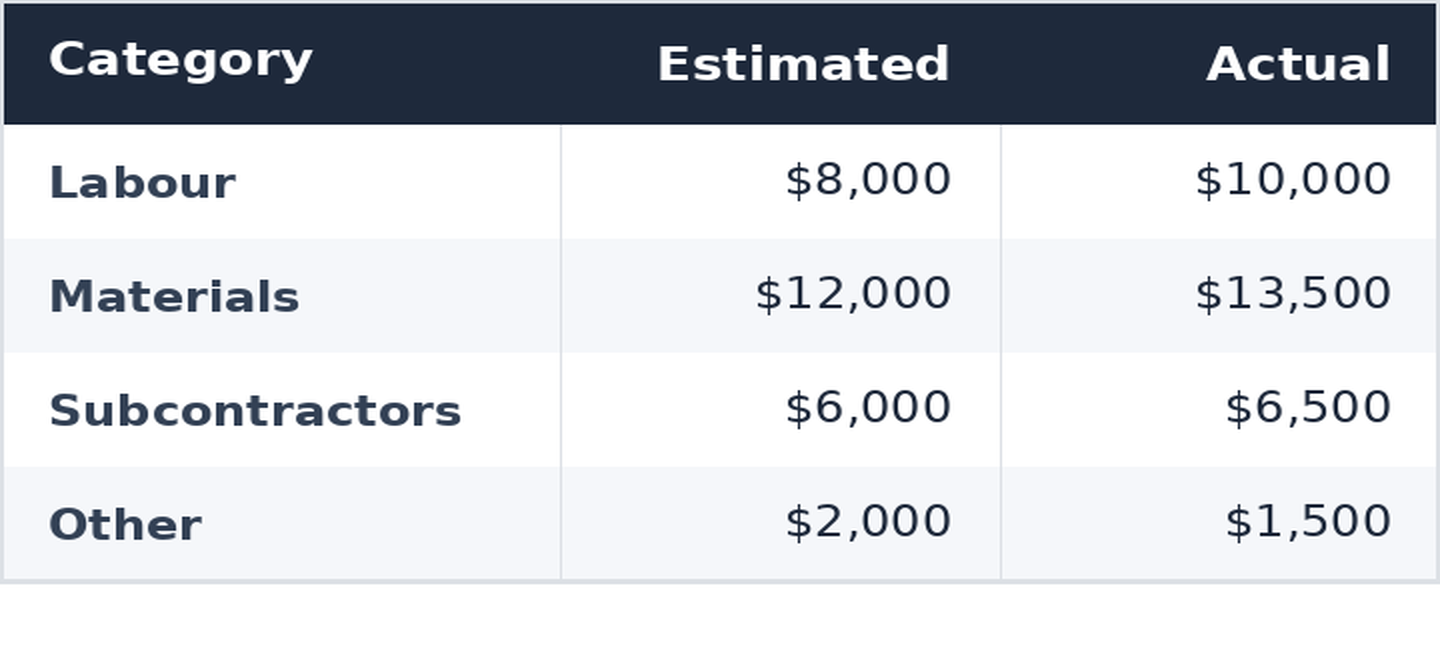
The total actual costs are higher than expected.
That’s important information.
But the real value comes from asking why.
Track the Major Cost Categories
The exact categories will vary depending on the type of contracting business, but common job costs include:
Labour
Track the labour associated with the project.
Materials
Materials can have a significant impact on profitability, particularly when prices fluctuate.
Subcontractors
Subcontractor costs should be assigned to the appropriate project whenever practical.
Equipment
Depending on the business and job, equipment-related costs may need to be considered.
Other Direct Costs
Other costs directly attributable to a project may also need to be tracked.
The goal isn’t to create unnecessary complexity.
The goal is to capture enough information to understand what happened.
Actual vs. Estimated
One of the most useful things you can do is compare:
What did we expect this job to cost?
with
What did it actually cost?
If the difference is significant, investigate.
Maybe labour took longer than expected.
Maybe material costs increased.
Maybe the scope changed.
Maybe the estimate wasn’t accurate.
Maybe the job simply wasn’t priced appropriately.
The numbers help you find the questions you need to ask.
Don’t Wait Until the Job Is Finished
Ideally, job costing shouldn’t be something you look at only after the project is complete.
Regular reviews can help you identify problems while there is still time to address them.
For example, if a job is already significantly over budget halfway through, that’s something you want to know now, not three months later.
Revenue Alone Doesn’t Tell the Story
Consider two jobs:
Job A
Revenue: $50,000
Costs: $35,000
Profit: $15,000
Job B
Revenue: $70,000
Costs: $60,000
Profit: $10,000
Job B generated more revenue.
But Job A generated more profit.
That’s why contractors shouldn’t automatically chase the biggest jobs.
Sometimes the better question is:
“Which work gives us the best return for the time, labour and resources required?”
What Should You Review Each Month?
For active jobs, consider reviewing:
Contract value
Amount invoiced
Amount collected
Estimated costs
Actual costs
Labour costs
Material costs
Subcontractor costs
Current gross profit
Expected final profit
The exact reports and process will depend on your business.
The Goal Isn’t Perfect Numbers
Job costing doesn’t need to become another administrative burden.
The goal is to create enough structure that your bookkeeping can answer useful business questions.
Are we pricing jobs correctly?
Are certain types of work more profitable?
Where are we losing margin?
Are our estimates accurate?
Are our costs under control?
Those are the questions that can actually change the way you run your business.
TRY OUR JOB PROFITABILITY CALCULATOR
If you’re ready to talk about your current bookkeeping system, you can also book a free Contractor Business Review
BOOK YOUR FREE CONTRACTOR BUSINESS REVIEW
Your books shouldn’t just tell you what happened. They should help you understand what to do next.
Your Bank Balance Isn’t Your Profit: What Contractors Need to Know
You check your business bank account.
There’s $40,000 sitting there.
It feels like a good month.
But can you actually say your business made $40,000?
Not necessarily.
Your bank balance tells you how much cash is in your account at a specific moment. It doesn’t tell you how profitable your business is.
For contractors, understanding the difference between cash and profit is especially important.
Cash Isn’t the Same as Profit
Imagine your contracting business receives a $30,000 customer payment.
Your bank account goes up by $30,000.
But that doesn’t mean you’ve earned $30,000 in profit.
You may still have:
Employee wages to pay
Subcontractor invoices
Material bills
Vehicle and equipment costs
Insurance
Rent or other overhead
GST obligations
Other upcoming expenses
The money may be in your account, but some of it already has a purpose.
That’s why looking only at your bank balance can give you a false sense of financial security.
So What Is Profit?
At a basic level, profit is what remains after the business’s expenses are accounted for against its revenue.
Your Profit & Loss statement helps you see this.
For example:
Revenue: $100,000
Direct/job costs: $60,000
Gross profit: $40,000
Overhead expenses: $25,000
Net income: $15,000
Your bank account could look very different from that $15,000.
That’s because cash flow and accounting profit measure different things.
Why Contractors Need to Watch Both
A healthy contracting business needs to understand two questions:
1. Is the business profitable?
Your financial statements can help answer this.
2. Do we have enough cash to meet our obligations?
Your cash position and cash-flow information help answer this.
You need both.
A business can be profitable but temporarily short on cash.
For example, you may have completed several large jobs and recorded the revenue, but your customers haven’t paid their invoices yet.
Meanwhile, you still need to pay your employees, suppliers and subcontractors.
That’s a cash-flow problem.
Accounts Receivable Can Make This Even More Complicated
Let’s say you’ve invoiced customers $75,000.
Your accounting records may show that money as revenue or receivables depending on the accounting method being used.
But if customers haven’t paid yet, that money isn’t sitting in your bank account.
This is why contractors should regularly review accounts receivable.
You should know:
How much customers owe you
Which invoices are overdue
How long invoices have been outstanding
When you reasonably expect payment
The goal is to avoid being surprised by your own cash flow.
What About Upcoming Bills?
The opposite can also happen.
You might have $40,000 in the bank, but $25,000 of bills are coming due.
If you look only at the bank balance, you may think you have $40,000 available.
In reality, a large portion of that cash may already be committed.
This is why regular accounts payable reviews matter too.
What Should Contractors Look at Every Month?
A useful monthly financial review should include more than your bank balance.
At minimum, look at:
Revenue
How much did the business generate?
Gross Profit
How much did you have left after direct costs?
Expenses
Are overhead costs increasing?
Accounts Receivable
How much money are customers still owing?
Accounts Payable
What bills need to be paid?
Cash
How much money is actually available?
Job Profitability
Which projects performed well?
Which ones didn’t?
The Question to Ask Yourself
Instead of asking:
“How much money do I have?”
Try asking:
“What does my current cash position tell me about my business?”
That question leads to much better financial decisions.
Your bank balance is important.
But it is only one piece of the picture.
Know More Than Your Bank Balance
Good bookkeeping gives you the ability to connect the dots between your cash, revenue, expenses, outstanding invoices and job profitability.
That’s where your numbers become useful.
Bricked Bookkeeping helps contractors and trades businesses organize their books and gain clearer financial visibility.
GET THE FREE CASH FLOW TRACKER
Or, if you’d rather talk through your current bookkeeping setup, book a free Contractor Business Review.
BOOK YOUR FREE CONTRACTOR BUSINESS REVIEW
Know your numbers. Know your business.
7 Bookkeeping Mistakes Contractors Make… And How to Avoid Them
Running a contracting business means keeping jobs moving, managing crews, ordering materials, dealing with customers and constantly thinking about what’s next.
Bookkeeping can easily become something you deal with when you have time.
The problem? There usually isn’t much time.
And when bookkeeping gets pushed aside, small issues can turn into bigger problems — making it harder to understand your cash flow, job profitability and overall financial position.
Here are seven of the most common bookkeeping mistakes contractors make.
1. Treating the Bank Balance as Profit
One of the biggest mistakes is assuming that the money sitting in your bank account represents how much money the business has actually made.
It doesn’t.
Your bank balance doesn’t account for outstanding bills, unpaid invoices, payroll obligations, GST or other upcoming expenses.
You could have $50,000 in the bank and still have significant financial obligations that haven’t been paid yet.
That’s why contractors need to look beyond their bank balance and regularly review their financial statements.
The goal isn’t just to know how much money is in the bank. It’s to understand what that money actually represents.
2. Not Tracking Profitability by Job
Revenue is exciting.
Profit is what matters.
A job that brings in $50,000 sounds great — but what did it cost you to complete?
Once you account for labour, materials, subcontractors and other job-related costs, the actual profit could look very different.
Without job costing, it can be difficult to identify:
Which jobs are most profitable
Which types of work are producing the best margins
Where costs are getting out of control
Whether estimates are accurate
Whether pricing needs to change
If you’re consistently winning work but not seeing the expected profit, job costing deserves a closer look.
3. Letting Accounts Receivable Get Out of Control
You’ve completed the work.
You’ve sent the invoice.
But the money hasn’t arrived.
Outstanding invoices can create serious cash-flow pressure for contractors, particularly when you’re paying employees, subcontractors and suppliers before your customer pays you.
Your bookkeeping process should make it easy to see:
What’s currently outstanding
Which invoices are overdue
How long customers are taking to pay
How much cash you should expect to receive
You shouldn’t have to dig through your accounting software to figure this out.
4. Falling Behind on Reconciliations
Bank and credit card reconciliations are one of those tasks that can seem easy to postpone.
A week becomes a month.
A month becomes three months.
Suddenly, you’re trying to figure out why the numbers don’t match.
Regular reconciliations help identify missing transactions, duplicate entries, incorrect postings and other issues before they become difficult to untangle.
Keeping your books current also means your financial reports are much more useful.
5. Mixing Personal and Business Expenses
Using business accounts for personal purchases — or personal accounts for business expenses — can make bookkeeping unnecessarily complicated.
It can create uncertainty about:
Which expenses belong to the business
How transactions should be categorized
What needs to be recorded as an owner transaction
How much the business is actually spending
Keeping business and personal finances separate makes your books cleaner and makes your financial information easier to understand.
6. Treating Subcontractor Costs as an Afterthought
Contractors often rely heavily on subcontractors, which means subcontractor costs can represent a significant portion of project expenses.
If those costs aren’t captured consistently, your job profitability reports may not tell the full story.
Your bookkeeping process should make it clear which subcontractor expenses relate to which jobs and ensure the supporting documentation is organized.
It’s also important to understand your applicable reporting and documentation obligations. Your bookkeeper can help keep your records organized, while tax-specific questions should be reviewed with your tax professional.
7. Only Looking at the Numbers When There’s a Problem
Your financial reports shouldn’t only come out when your accountant asks for them.
By then, you’re looking backward.
A monthly financial review gives you an opportunity to ask:
How did we perform this month?
Are our margins improving?
What’s happening with expenses?
How much is outstanding from customers?
What bills are coming up?
Which jobs are performing well?
What needs attention?
The purpose of bookkeeping isn’t simply to record what happened.
It’s to give you information you can use to decide what happens next.
The Bottom Line
Good bookkeeping doesn’t need to be complicated.
But it does need to be consistent.
For contractors, the most valuable bookkeeping systems are the ones that provide visibility into cash flow, profitability, job costs and financial performance.
If you’re not sure whether your current bookkeeping process is keeping up with your business, start with the basics.
Start With a Monthly Review
Bricked Bookkeeping created the Contractor’s Monthly Bookkeeping Checklist to help contractors and trades business owners review the key areas of their books each month.
GET THE FREE CONTRACTOR BOOKKEEPING CHECKLIST
And if you’d rather talk through your current setup, you can book a free Contractor Business Call with Bricked Bookkeeping.
You know how to run the job.
We help you understand the numbers behind it.
If You Don’t Know Your Gross Margin Per Job, You’re Guessing

A lot of contractors know their revenue.
Fewer know their net profit.
Almost none know their gross margin per job.
And that’s where the real story lives. Because if you don’t know your gross margin per job, you’re not managing profitability — you’re hoping for it.
⸻
Revenue Is Activity. Margin Is Health.
You can run a $2M company and still feel constant financial pressure.
Why?
Because revenue tells you how busy you are.
Gross margin tells you how well your jobs are performing.
Gross margin per job shows you:
• Whether your pricing is accurate
• Whether labour hours are being estimated properly
• Whether materials are eating into profit
• Whether certain scopes consistently underperform
Without that visibility, every project blends into one big number on your P&L.
And blended numbers hide problems.
The Hidden Danger of “Overall Profit”
Let’s say your company runs at a 30% gross margin overall.
On paper, that looks solid.
But what if:
• One type of job runs at 45%
• Another runs at 15%
• And a third is quietly losing money
The 30% average hides all of that.
So you keep bidding the low-performing jobs.
You keep sending crews to scopes that drain time.
You assume the market is tight.
When in reality, the issue may be internal.
Markup Is Not the Same as Margin
Many contractors price using consistent markup.That’s a starting point.But markup sets the price — it does not guarantee the outcome.Gross margin per job shows whether: • Labour ran over estimate • Materials fluctuated • Subcontractors exceeded budget • Change orders were missedTwo jobs with identical markup can produce very different margins.If you don’t measure it, you can’t manage it.Busy Doesn’t Mean Profitable
Some of the most financially stressed contractors are fully booked.
They’re working hard.
Crews are active.
Projects are moving.
But cash is tight.
Often, it’s because small margin leaks across multiple jobs compound over time.
Without job-level tracking, those leaks remain invisible.
What Knowing Your Gross Margin Per Job Changes
When you have clear visibility:
• You bid smarter.
• You price with confidence.
• You identify high-performing scopes.
• You cut or correct underperforming work.
• You stop relying on the bank balance as your decision tool.
You move from reactive to strategic.
And that’s when growth becomes sustainable.
The Bottom Line
If you don’t know your gross margin per job, you’re not operating with full information.
You’re operating on averages.
And averages are dangerous in a business where every job matters.
Clarity doesn’t complicate your business.
It protects it.
If you’re a trades business owner and you want clearer visibility into how your jobs are actually performing, it starts with structure — not guesswork.
Because busy isn’t the goal.
Profitable is.
Bookkeeping for Trades Contractors in Edmonton: What You Actually Need
Running a trades business in Edmonton isn’t simple.
You’re managing crews, quoting jobs, ordering materials, handling callbacks, and trying to keep projects moving — all while attempting to keep your books up to date at night or on weekends.
Most contractors don’t struggle because they don’t understand business.
They struggle because they don’t have time to manage both the workload and the financial systems properly.
Here’s what trades contractors in Edmonton actually need when it comes to bookkeeping — and what most generic bookkeeping services miss.
1. Clean Monthly Reconciliations (Not Catch-Up Chaos)
Many contractors only look at their books when:
• GST is due
• Year-end is approaching
• The bank balance feels tight
That creates stress and last-minute scrambling.
What you actually need is consistent monthly reconciliations:
• Bank accounts balanced
• Credit cards reconciled
• Vendor payments categorized correctly
• No “uncategorized expense” buildup
Clean books monthly means no surprises later.
2. Job Cost Visibility — Not Just Expense Tracking
Trades businesses are project-driven.
If you can’t clearly see:
• Material costs per job
• Labour allocation
• Subcontractor costs
• Gross profit per project
Then you’re operating on instinct instead of data.
Proper bookkeeping for contractors in Edmonton must include job-cost structure inside QuickBooks Online:
• Classes or locations
• Customer/job tracking
• Clear cost-of-goods-sold categories
This is what separates hobby bookkeeping from operational bookkeeping.
3. GST Managed Properly (Alberta-Specific Awareness)
In Alberta, contractors often deal with:
• Multiple invoices outstanding
• Progress billing
• Deposits
• Subcontractor expenses
GST mistakes are common when revenue isn’t recorded correctly or expenses are misclassified.
What you need:
• GST tracked consistently
• Clean reporting for filing
• No guessing at quarter-end
Your books should make GST filing routine — not stressful.
4. Year-End Ready Financials
Accountants don’t want:
• 6 months of catch-up work
• Hundreds of miscoded transactions
• Missing documentation
And you shouldn’t be paying cleanup fees every year.
A properly structured bookkeeping system ensures:
• Accurate income statement
• Clean balance sheet
• Organized vendor history
• Clear loan and equipment tracking
That reduces accounting costs and protects your margins.
5. Structured Monthly Reporting
Many trades contractors only look at the bank balance.
But growth decisions require more than that.
You need to see:
• Revenue trends
• Gross margin percentage
• Overhead vs direct costs
• Cash flow movement
Monthly reporting creates clarity.
Clarity creates control.
6. Systems — Not Just Data Entry
Good bookkeeping isn’t about typing invoices.
It’s about building systems that support:
• Vendor invoice submission
• Organized receipt capture
• Payroll tracking
• Monthly workflow discipline
Trades businesses grow when their backend becomes predictable.
Without structure, financial management becomes reactive.
Why Trades Businesses in Edmonton Need Specialized Bookkeeping
Construction, electrical, HVAC, plumbing, and service contractors all have unique patterns:
• Seasonal fluctuations
• Large equipment purchases
• Crew payroll complexity
• Fuel and vehicle tracking
• Job deposits and progress billing
Generic bookkeeping often misses these nuances.
Specialized bookkeeping builds around them.
When It’s Time to Stop Doing It Yourself
If you:
• Update QuickBooks once every few months
• Aren’t confident in your job profitability
• Avoid looking at your reports
• Scramble during GST season
• Feel like the books are always behind
It may be time to transition from DIY to structured support.
Not because you can’t do it.
But because your time is better spent running jobs, quoting work, and growing revenue.
Building Financial Infrastructure That Supports Growth
Trades contractors in Edmonton don’t need more apps.
They need:
• Clean books
• Predictable monthly processes
• Clear reporting
• Accountant-ready financials
When your financial systems are structured, decisions become easier.
And growth becomes intentional — not reactive.
If you’re a trades contractor in Edmonton looking to bring structure to your bookkeeping, Bricked Bookkeeping specializes in building clean, consistent financial systems designed specifically for growing trades businesses.
Learn more at:
www.brickedbookkeeping.com