

How to Track Profitability by Job: A Contractor’s Guide
For contractors, knowing how much revenue the business generated is important.
But there’s another question that can be even more valuable:
Which jobs actually made money?
If you don’t track costs by job, it can be difficult to answer.
You might have a busy schedule, plenty of invoices going out and strong revenue — while some of your projects are producing far less profit than expected.
That’s where job costing comes in.
What Is Job Costing?
Job costing is the process of tracking the revenue and costs associated with a specific project.
Instead of looking only at your business as a whole, you can look at individual jobs.
For example:
Job A
Contract price: $40,000
Labour: $10,000
Materials: $12,000
Subcontractors: $7,000
Other direct costs: $2,000
Estimated job profit: $9,000
Now you have something useful to measure.
Why Job Costing Matters
Without job costing, you may know:
“We made $500,000 this year.”
But you may not know:
“Which type of work generated the best margins?”
That’s a much more useful question.
Job costing can help you identify:
Your most profitable types of work
Jobs that consistently run over budget
Cost categories that are increasing
Estimating problems
Pricing issues
Labour inefficiencies
Material overruns
Subcontractor costs that weren’t anticipated
It can also help you make better decisions about future jobs.
Start With Your Estimate
Good job costing starts before the job begins.
Your original estimate or budget gives you something to compare against.
For example:
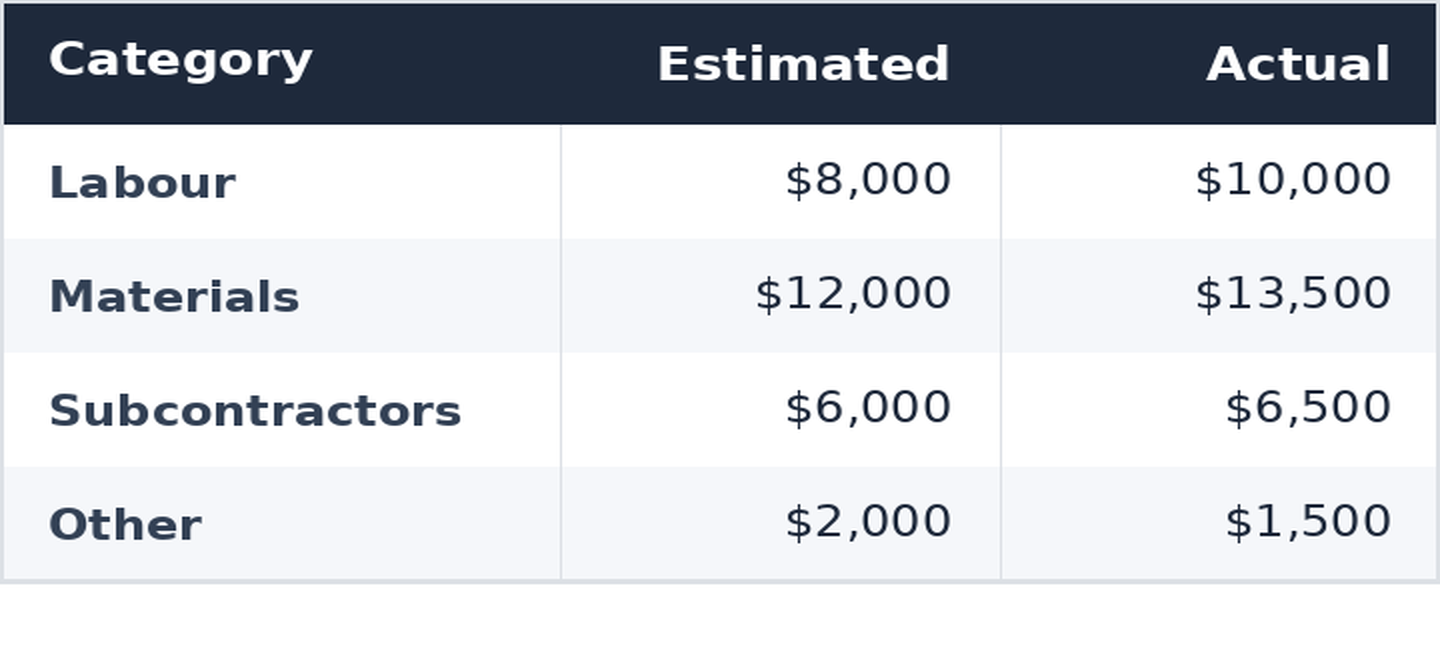
The total actual costs are higher than expected.
That’s important information.
But the real value comes from asking why.
Track the Major Cost Categories
The exact categories will vary depending on the type of contracting business, but common job costs include:
Labour
Track the labour associated with the project.
Materials
Materials can have a significant impact on profitability, particularly when prices fluctuate.
Subcontractors
Subcontractor costs should be assigned to the appropriate project whenever practical.
Equipment
Depending on the business and job, equipment-related costs may need to be considered.
Other Direct Costs
Other costs directly attributable to a project may also need to be tracked.
The goal isn’t to create unnecessary complexity.
The goal is to capture enough information to understand what happened.
Actual vs. Estimated
One of the most useful things you can do is compare:
What did we expect this job to cost?
with
What did it actually cost?
If the difference is significant, investigate.
Maybe labour took longer than expected.
Maybe material costs increased.
Maybe the scope changed.
Maybe the estimate wasn’t accurate.
Maybe the job simply wasn’t priced appropriately.
The numbers help you find the questions you need to ask.
Don’t Wait Until the Job Is Finished
Ideally, job costing shouldn’t be something you look at only after the project is complete.
Regular reviews can help you identify problems while there is still time to address them.
For example, if a job is already significantly over budget halfway through, that’s something you want to know now, not three months later.
Revenue Alone Doesn’t Tell the Story
Consider two jobs:
Job A
Revenue: $50,000
Costs: $35,000
Profit: $15,000
Job B
Revenue: $70,000
Costs: $60,000
Profit: $10,000
Job B generated more revenue.
But Job A generated more profit.
That’s why contractors shouldn’t automatically chase the biggest jobs.
Sometimes the better question is:
“Which work gives us the best return for the time, labour and resources required?”
What Should You Review Each Month?
For active jobs, consider reviewing:
Contract value
Amount invoiced
Amount collected
Estimated costs
Actual costs
Labour costs
Material costs
Subcontractor costs
Current gross profit
Expected final profit
The exact reports and process will depend on your business.
The Goal Isn’t Perfect Numbers
Job costing doesn’t need to become another administrative burden.
The goal is to create enough structure that your bookkeeping can answer useful business questions.
Are we pricing jobs correctly?
Are certain types of work more profitable?
Where are we losing margin?
Are our estimates accurate?
Are our costs under control?
Those are the questions that can actually change the way you run your business.
TRY OUR JOB PROFITABILITY CALCULATOR
If you’re ready to talk about your current bookkeeping system, you can also book a free Contractor Business Review
BOOK YOUR FREE CONTRACTOR BUSINESS REVIEW
Your books shouldn’t just tell you what happened. They should help you understand what to do next.